Coupler
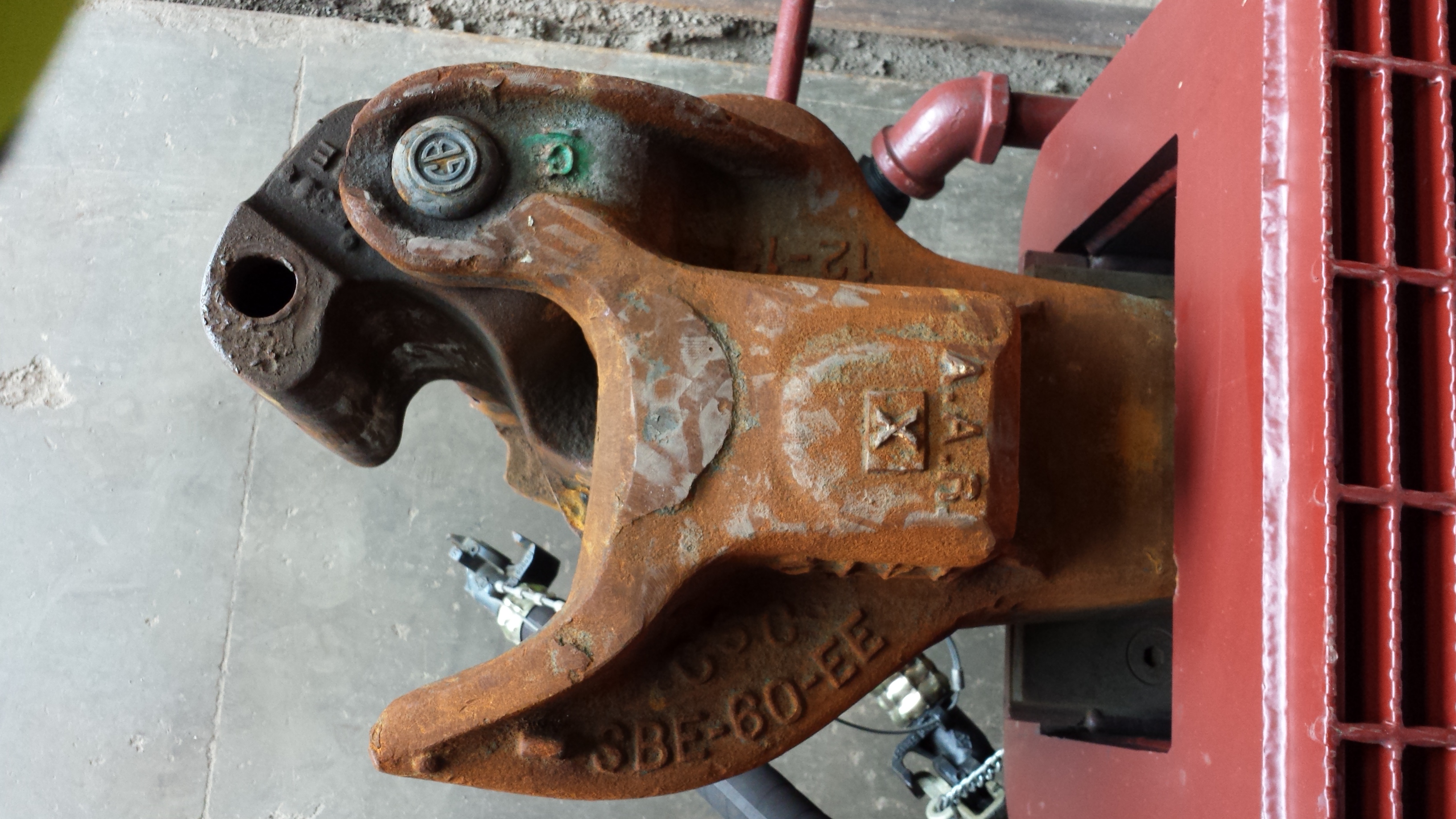 A coupler is the device which allows two adjacent pieces of rolling stock to remain connected in a train such that it can be quickly released without stepping between the equipment.
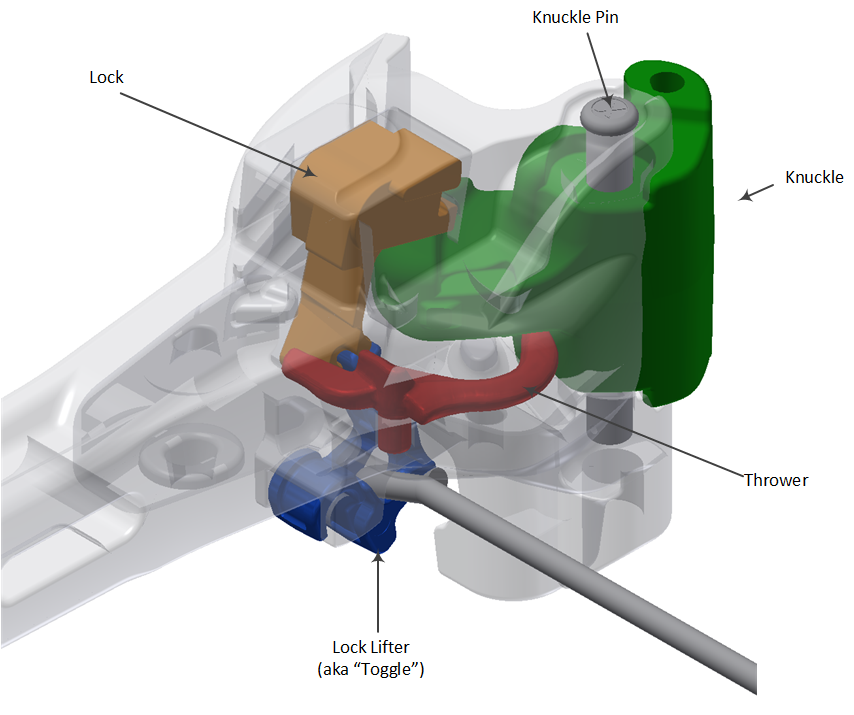 The term "coupler" can typically refers to the coupler assembly as a whole, which includes the coupler body, knuckle,knuckle pin,thrower,lock lifter, and the lock. This assembly is sometimes referred to on parts lists as "coupler complete".
A coupler, also known as a "drawhead", is not to be confused with a drawbar, which serves a similar purpose but is a more permanent connection with no moving parts.
History
Link and Pin Coupler
The link and pin coupler consisted of a large link connected to cars by means of a pin.
Janney Coupler
[caption id="attachment_718" align="alignright" width="300"]  The Janney coupler in 1973[/caption]
Although earlier attempts at replacing the dangerous link-and-pin couplings were made, such as an 1871 design by Edward D. Meier in resembling two interlocking arrowheads, the modern coupler is typically attributed to the design patented in 1873 by Eli H. Janney.
Adoption by the Master Car Builder's Association
In 1887, the Master Car Builder's Assocation adopted the automatic coupler as its standard
Burns' Automatic Coupler
[caption id="attachment_714" align="alignleft" width="300"]  The Burns Coupler in 1893[/caption]
In 1893, Willis B.Burns patented several improvements known today as a lock and thrower, which he described as a "gravitating latch" and "lever by which the knuckle is thrown outward". At the time, link-and-pin couplings were the norm, so to ease the tradition Burns' design also incorporated a slotted knuckle that could accept a link and pin.
This same year, the Railroad Safety Appliance Act of 1893 mandated that link-and-pin style couplers be phased out and replaced with "automatic couplers" before 1898.
[caption id="attachment_713" align="aligncenter" width="300"]  Transition era (pre-1898) knuckle coupler. The gap in the knuckle accommodates the link of a link and pin coupler and the vertical hole in the knuckle accommodates the pin.
CC BY-SA 3.0 Wikimedia Commons[/caption]
See it in action: