Drawbar
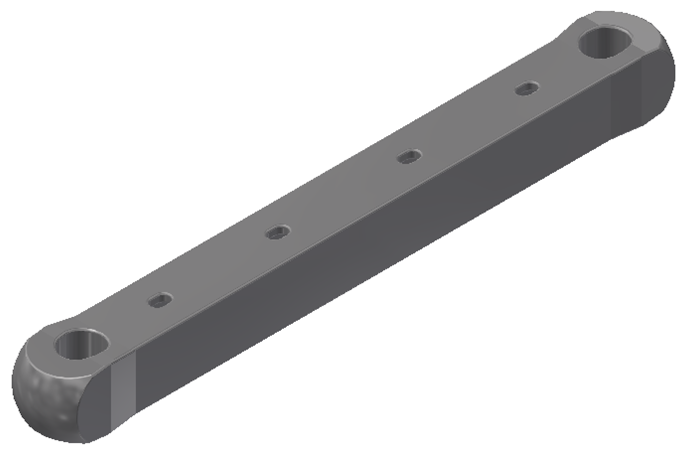 A drawbar is a rigid bar that connects two cars semi-permanently, taking the place of the usual couplers between them. Where a coupler is built so that two cars can be uncoupled quickly by hand, a drawbar is a fixed connection with no moving locking parts.
Where It Sits
A drawbar replaces the couplers at the connected ends of two cars. How it attaches depends on the design: some drawbars connect through a yoke into the car's draft gear or cushion unit much as a coupler does, while many modern slackless drawbar systems take the place of the yoke and draft gear entirely and are retained by a horizontal key or a vertical pin. In all cases the connection is meant to stay made, so separating drawbar-connected cars requires special tools and equipment rather than simply lifting an uncoupling lever.
What It Does
The drawbar transmits the same draft (pulling) and buff (pushing) forces between cars that a coupler would, passing those loads through the yoke and into the draft sill of each car. It is used to join cars that are intended to travel together as a set, such as the units of a multi-unit car. By eliminating the coupler's moving parts and slack, the drawbar makes a tighter, lighter, lower-maintenance connection between the permanently paired units while still letting them swing relative to each other on curves.
Inspection
Drawbars, their pins, and the connected draft components are inspected for cracks, wear, and proper retention. Condemnable conditions and limits for drawbars and draft connections are defined in the AAR interchange rules and field manual.